
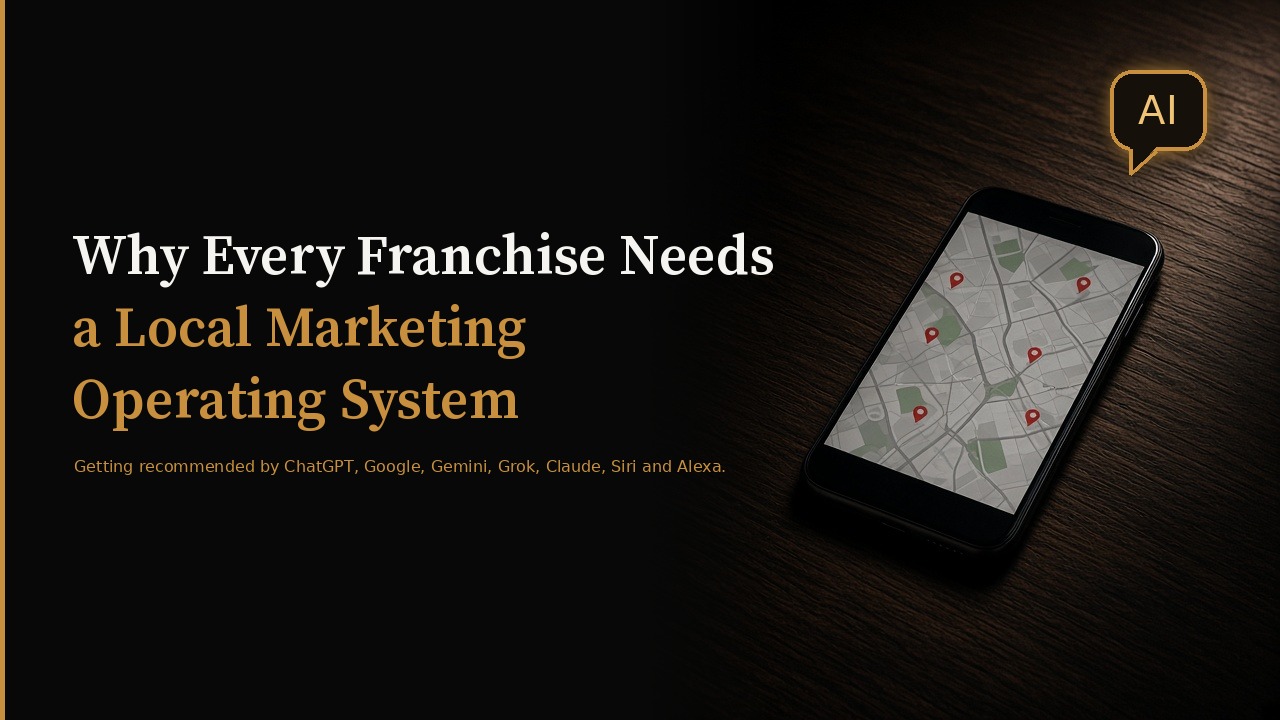
Short answer: A local marketing operating system is one weekly system, with one view per location, for the things that decide whether a customer picks you: reviews, review requests, your Google Business Profile, photos, posts and location pages. Instead of scattered vendors, logins and spreadsheets, every location gets checked the same way every week. That matters more now that ChatGPT, Google, Gemini, Grok, Claude, Siri and Alexa lean on those same signals to decide which location to recommend.
How many logins does it take to answer one simple question about your own business?
How is each of my locations doing locally this week?
For a lot of franchise owners, the honest answer is "I'd have to check." The reviews live in one place. The Google Business Profile lives in another. The website belongs to a vendor, and changes go through corporate review. Photos are on somebody's phone. Review requests are supposed to go out from the field, but nobody is quite sure they did. And there's a spreadsheet somewhere that was accurate in March.
None of those pieces is broken on its own. The problem is that nobody is running them together.
That's what a local marketing operating system fixes.
What is a local marketing operating system?
It's one weekly system for the local signals that get a location picked, with one view per location.
That's it. Think about how you already run operations. You don't let every crew invent its own way to run a job. You have a process, a schedule and a way to see which jobs are on track.
Most franchises run their trucks that way. Very few run their local marketing that way.
An operating system for local marketing means the same checklist, the same rhythm and the same scoreboard for every location, every week.
Why is franchise local marketing so scattered?
Because it got built one piece at a time.
Somebody signed up for a review tool. Somebody else hired a website vendor. Corporate has brand standards and a review process for pages, which makes sense when you're protecting a national name. Then the person who handled marketing left and took three logins with them.
Every one of those decisions was reasonable. Stack them up and you get a mess with no owner.
Here's where I'll push back. The fix usually isn't another agency. A lot of agencies get paid to stay complicated. Monthly reports full of charts and a vague promise that "SEO takes time." Meanwhile, nobody can tell you if your crew asked for a review last Tuesday.
You don't need more activity. You need a system you can see.
What should a local marketing operating system include?
Keep it to the things customers and AI actually look at. For each location:
- Reviews. New reviews this week, the star rating and any reviews still waiting on a reply.
- Review requests. How many asks went out this week. Most teams never look at this number, and it usually explains everything else.
- Missing reviews. Reviews that were there last week and aren't now. If nobody notices, nobody follows up with Google support.
- Google Business Profile. Categories, services, hours and service area that match what the location really does.
- Photos. Recent, real photos of the crew, the trucks and the work, used with the customer's permission.
- Posts. Something new on the profile on a regular basis, so it looks alive.
- Location pages. A page on the website for each location that says what it does and where, and that has made it through corporate review.
If a tool or a report doesn't help you see one of these, ask why you're paying for it.
Why are review requests the number to watch?
Because reviews don't show up on their own. Somebody has to ask.
Some franchise teams go a whole week sending zero review requests. Not because they don't care. Because the ask isn't built into the job. It's a "when we remember" thing, and busy crews don't remember.
You can't fix a review problem by staring at your star rating. The rating is the result. The asks are the cause. If you only track one number per location every week, track how many review requests went out.
Then make the ask easy. A text with a link, sent by the tech before they leave. Ask the customer to mention what you did. Those details are what the next customer, and the next AI answer, will use.
Why do AI recommendations make this urgent?
Because AI doesn't recommend your brand. It recommends a location.
When someone asks an AI assistant who to call, it looks for the nearby location it understands and trusts. It reads profiles, websites and reviews to figure that out. A location with a complete profile, fresh detailed reviews and a clear location page gives it something to say. A location that went quiet doesn't.
So your weakest location isn't just a little behind. It may be invisible to the tools more and more customers are asking first. I wrote more about that in Every Location Counts and in When AI Picks the Restoration Company.
AI picks one, maybe three. Every one of your locations should have a real shot at being that pick.
What does a weekly local marketing rhythm look like?
Pick a set time every week and keep it short. Here's the rhythm:
- Look at the board. Every location side by side: new reviews, unanswered reviews, requests sent, photos and the last post. Whether you do it in a spreadsheet or use a tool like Were You Happy, the point is one view, not five logins.
- Find the quietest location. There's always one. Fewest asks, oldest photos, longest since a post.
- Fix one thing there. Reply to reviews, add this week's photos, update services or post something.
- Call about the zeros. Any location at zero review requests gets a phone call, not an email. Find out what's in the way. Usually it's that nobody owns it.
- Flag what's missing. If reviews vanished, note which ones and start the support request now.
- Move one website item forward. Submit one location page fix for corporate review. In my experience, small and steady changes are easier to approve than a giant rebuild nobody wants to sign off on.
Then do it again next week. The power is in the repetition.
How does this work with corporate brand rules?
It works inside them, not around them.
Brand standards and approval processes exist for good reasons. A national brand can't have every location making up its own claims. Whether you run a SERVPRO or another franchise, the goal isn't to fight corporate. It's to stop work from sitting in limbo.
Keep a simple list for each location: what's approved, what's waiting on review and what's live. When something gets stuck, you'll know where, and you can follow up with a clear ask.
Frequently asked questions
What is a local marketing operating system for a franchise?
It's one weekly system, with one view per location, for reviews, review requests, Google Business Profile, photos, posts and location pages. Every location gets checked the same way, on the same schedule.
Why do franchise locations need their own reviews and profiles?
Because customers and AI tools look for the location near them, not the brand in general. Each location needs its own complete profile and its own steady stream of reviews.
How often should a franchise check its local marketing?
Every week. A short check catches quiet profiles, unanswered reviews and zero-request weeks before they turn into months.
What should I do when Google reviews disappear?
Write down which reviews went missing and when, then open a request with Google support right away. A weekly check is what lets you notice in time.
How do AI assistants decide which franchise location to recommend?
They look for the nearby location they understand and trust most, using its Google Business Profile, its website and the words in its reviews. Complete, current information and fresh detailed reviews give them a reason to say your name.
Can you see every location in one view?
Try it this week. Pull up every one of your locations side by side and answer one question: how many review requests did each one send?
If you can't answer that in one place, that's your answer. Message me on LinkedIn with how many locations you run and how you check them today. I'll tell you where I'd start.