I just watched a LinkedIn post go viral about the latest jobs report. Soft numbers. Downward revisions. The usual hand-wringing about economic headwinds and uncertainty.
And I thought: we're still not saying the obvious thing out loud.
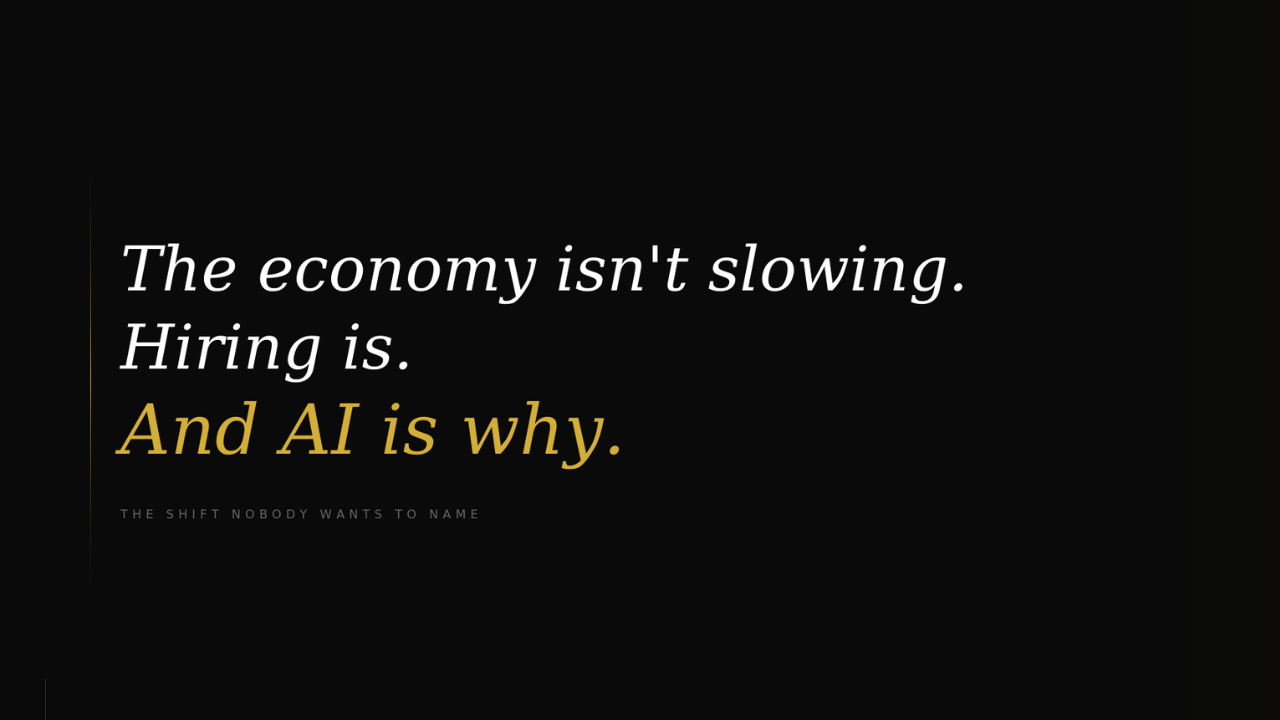
The economy is not slowing down. Hiring is. And AI is a massive reason why.
But that's uncomfortable to say. It doesn't fit neatly into the "everything is fine" narrative or the "sky is falling" doom scroll. So instead we get economists doing their economist cosplay, talking about seasonal adjustments and labor force participation rates while completely missing what's actually happening on the ground.
Let me tell you what I'm seeing with real businesses. Not theory. Not projections. What's actually happening right now.
The Shift Nobody Wants to Name
I had a conversation last month with the CEO of a marketing agency. Good guy. Smart operator. He told me something that stuck with me.
"Sean, I used to have 14 people doing what 4 people do now. And the 4 are better."
That's not an exaggeration. That's not some AI hype pitch. That's a real business owner describing what happened to his org chart over 18 months.
He didn't lay off 10 people in some dramatic restructuring. They left naturally. Attrition. Better opportunities. Life changes. And he just... didn't replace them. Because he didn't need to.
His team learned to use AI tools. Not perfectly. Not like some sci-fi movie. Just competently. And competent use of AI tools made each person dramatically more productive.
One person with AI now does the work of three to five people from five years ago.
That's not a headline from a tech conference. That's the reality I see in business after business, across industries, right now.
Where Jobs Are Actually Going
Here's what the jobs reports are showing if you read between the lines.
Food service is growing. Health care is growing. These sectors keep adding jobs because they're hard to fully automate. When something requires physical presence, emotional intelligence, or handling messy human situations, you still need humans.
You can't automate a nurse holding someone's hand during a scary diagnosis. You can't automate a server reading a table and knowing when to check in without interrupting. The physical, emotional, and unpredictable parts of work remain stubbornly human.
But retail? Shrinking. And not because of some temporary downturn.
Self-checkout killed cashier jobs. AI-powered demand forecasting eliminated inventory planners. Automated systems handle what used to require entire departments. This decline is not cyclical. It's structural. Those jobs are not coming back when the economy "improves" because the economy isn't the problem.
The middle of the org chart is getting hollowed out. Not the hands-on workers at the bottom. Not the strategic decision-makers at the top. The middle. The coordinators, the analysts, the junior managers, the people whose job was essentially moving information from one place to another.
AI does that now. Faster. Cheaper. Without taking lunch breaks.
The White Collar Quiet Erosion
Let's talk about what's happening in office jobs because this is where it gets uncomfortable for a lot of people.
Marketing departments are shrinking. Not because marketing matters less. Because one skilled marketer with AI tools can produce what a team of five produced before.
I know a company that used to have three people writing blog content, two people doing social media, a designer, an analytics person, and a manager coordinating all of them. Eight people. Now they have two. A strategist and a creator. They use AI for first drafts, image generation, data analysis, and scheduling. Same output. Sometimes better. Fraction of the headcount.
Operations teams are getting leaner. Customer support departments are smaller. Finance and accounting groups are running with skeleton crews. Admin roles are vanishing.
The hiring freezes you're reading about aren't because businesses are scared. They're because businesses realized they don't need as many people anymore. They did more with less during the pandemic out of necessity. Then they discovered they preferred it that way.
Why the Data Looks So Weird
Those downward revisions to October and November jobs numbers? The ones economists are puzzling over? That's a tell.
During major technological shifts, labor data gets messy. Job classifications were designed for a different era. The Bureau of Labor Statistics is trying to count something that's changing faster than their categories can adapt.
Where do you classify someone who runs a one-person consulting business using AI to do work that used to require a team? They're not traditionally employed. They're not unemployed. They're not even a freelancer in the classic sense. They're something new.
The productivity gains from AI don't show up cleanly in government reports. You see slower hiring before you see layoffs. Companies stop adding headcount before they start cutting it. That's exactly what this data reflects.
We're in the messy middle of a transition. And the people analyzing it are using last century's measuring tools.
The Unemployment Rate Lie
Unemployment ticked down to 4.4%. On paper, that looks healthy. Strong economy, right?
Not so fast.
When you see low unemployment paired with weak job creation, something weird is happening. Usually it means people are leaving the traditional job market entirely.
Some are retiring early. Some are freelancing. Some are stacking contract work from multiple clients. Some are running small businesses that don't register as payroll jobs.
And increasingly, some are running AI-assisted micro-businesses. One person operations that generate real income but don't look like "jobs" to the government trackers.
The economy is fragmenting. Not collapsing. Fragmenting.
People are finding ways to make money that don't involve being Employee Number 47,582 at a company with a benefits package and an org chart. AI is making that possible. When one person can do the work of three, you don't need to work for someone else if you don't want to.
What's Really Happening
Let me cut through all the analysis and just say it plainly.
The economy is moving from labor-heavy growth to leverage-heavy growth. AI is the leverage.
In the old model, growing a business meant hiring more people. Want to handle more customers? Hire more support staff. Want to create more content? Hire more writers. Want to expand to new markets? Hire more salespeople.
In the new model, growing a business means getting better at using tools. Want to handle more customers? Implement better AI support systems. Want to create more content? Train your existing people on AI tools. Want to expand to new markets? Use AI to localize and customize without adding headcount.
Fewer hires. Higher output. Same revenue growth.
This creates massive pressure on what I call low-differentiation roles. If your job is primarily processing information, following templates, or doing work that can be clearly defined in a procedure, you're competing with AI now. Not theoretically. Right now.
And AI works nights and weekends. AI doesn't need benefits. AI doesn't call in sick.
The Opportunity Nobody Mentions
Here's where I'm supposed to offer some hopeful message about how this isn't so bad. And honestly, I do think there's opportunity here. Just not in the way the optimists frame it.
The opportunity is for people who learn to use AI instead of compete with it.
I know a financial analyst who used to spend 20 hours a week building reports. Now he spends 4 hours because AI does the data compilation and initial analysis. He uses those 16 recovered hours to actually talk to clients, build relationships, and bring in new business. His value to his company went up dramatically. His job security increased.
I know a marketing director who was worried about AI replacing her team. Instead, she made everyone on her team learn the tools. Now her department produces twice the output on the same budget. Her CEO thinks she's brilliant. Her department is the last one that would ever get cut.
The people who figure out how to work alongside AI are becoming more valuable, not less. The ones waiting for things to go back to normal are in trouble.
What This Means For Business Owners
If you run a business, here's what I'd be thinking about right now.
First, stop hiring for roles AI can do. Before you post that job listing, ask yourself honestly: could a current employee with AI tools do this work? If the answer is yes or even maybe, don't hire. Train instead.
Second, look at your team differently. Your best people aren't necessarily the ones with the most experience or credentials. They're the ones most willing to adapt and learn new tools. Identify them. Invest in them. They're your future.
Third, rethink your growth model. The old playbook of "more revenue equals more headcount" is outdated. Companies that figure out how to scale revenue while keeping headcount flat will have massive competitive advantages. Better margins. More agility. Less overhead.
Fourth, prepare for the talent market to split. There will be a small pool of highly valuable operators who know how to leverage AI effectively. They'll be expensive and in demand. There will be a much larger pool of people with traditional skills who struggle to compete. The middle is disappearing.
What I'd Tell My Kids
I have this conversation with young people all the time. They ask what they should study, what careers to pursue, how to prepare for the job market.
My answer has changed dramatically in the last two years.
I used to say: develop valuable skills and you'll always have options.
Now I say: develop valuable skills AND learn to amplify them with AI. Either one alone isn't enough.
The history major who can write beautifully AND use AI to research, outline, and edit will outcompete both the AI-only content farm and the traditional writer who refuses to adapt.
The financial analyst who understands the numbers AND can use AI to process them ten times faster will be more valuable than either the pure technician or the pure relationship person.
The marketers, operators, analysts, and creators who figure out this hybrid approach will thrive. Everyone else is in a race to the bottom against machines that never sleep.
The Uncomfortable Truth
If I were writing that viral LinkedIn post with clarity instead of safe reporting, here's what it would say:
The economy is not slowing. Hiring is. And AI is a big reason why.
We're not going back to the old normal. The companies that are hiring fewer people are not suffering. They're thriving. They figured out what most businesses haven't accepted yet: you don't need as many people as you think you do.
This is uncomfortable because it means a lot of jobs aren't coming back. Not because of a recession. Not because of policy. Because the work itself has changed.
The question is not whether this is happening. It is happening. Right now. The question is whether you're positioning yourself on the winning side of the shift or pretending it's not real.
I know which side I'd want to be on.
Ready to position your business for what's actually happening?
Let's talk. Book a call and let's figure out how to make AI work for you instead of against you.
SML
.png)
.png)